Introducción
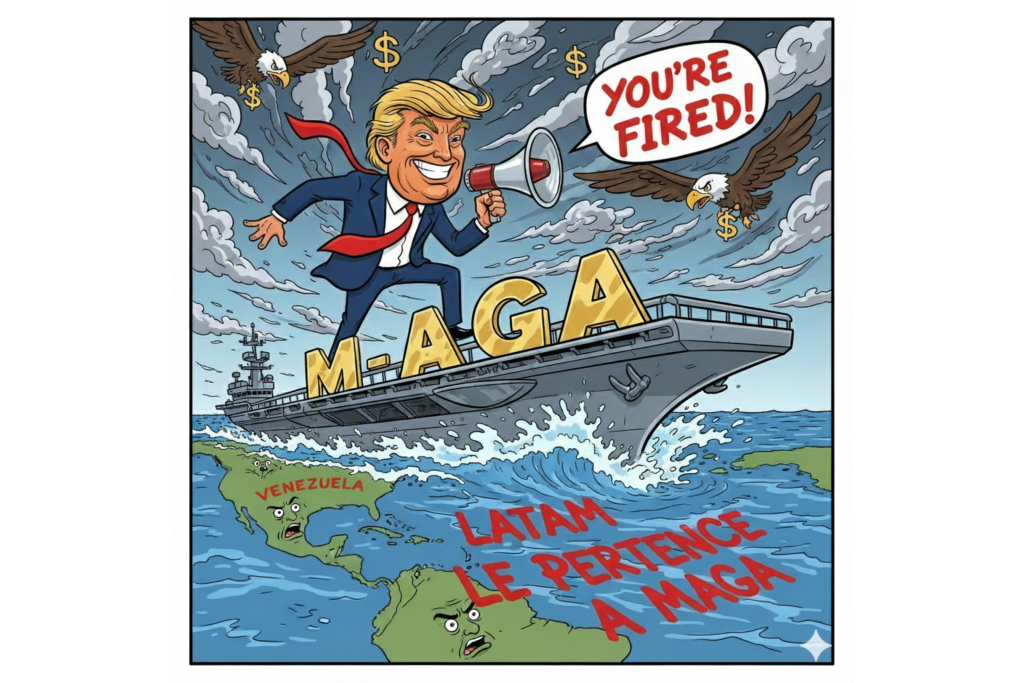
Trump quiere que toda LATAM sea MAGA. A principios de diciembre la Casa Blanca publicó La Estrategia de Seguridad Nacional (NSS) de 2025. He copiado los más importante y estoy incluyendo un Link al final (Apéndice). El presidente Trump marca un cambio profundo en el compromiso de EE.UU. con América Latina. ¿Qué dice la estrategia?: EEUU debe dominar el hemisferio mediante una versión actualizada de la Doctrina Monroe, ahora reformulada como el “Corolario Trump”. La estrategia combinada prioriza el control migratorio, la erradicación de carteles, el proteccionismo económico y el retroceso de China y Rusia en el hemisferio occidental.
No llama explícitamente a instalar gobiernos de derecha, pero describe un sistema de incentivos, presiones y alianzas condicionadas que favorece efectivamente a gobiernos nacionalistas, conservadores y anti-China. El énfasis no es el alineamiento económico tradicional de libre mercado, sino el nacionalismo económico tipo MAGA, la cooperación en seguridad y la compatibilidad ideológica.

1. El “Corolario Trump” a la Doctrina Monroe
La estrategia reafirma sin ambigüedad la hegemonía de EE.UU. en el hemisferio occidental, enmarcando a América Latina como una línea de defensa frente a adversarios extranjeros.
Elementos Clave
- Exclusión de adversarios no hemisféricos: China, Rusia e Irán deben ser excluidos de posiciones militares, estratégicas o económicas.
- Activos e infraestructura estratégicos: Puertos, redes energéticas, telecomunicaciones y minerales críticos se consideran asuntos de seguridad nacional para EE.UU.
- La soberanía redefinida: Se alienta a los países latinoamericanos a “proteger su soberanía”, pero EE.UU. se reserva el derecho de intervenir cuando detecta “coerción” extranjera o riesgos estratégicos.
Implicaciones
- Presión sobre gobiernos de izquierda o alineados con China.
- Mayor presencia militar e inteligencia de EE.UU.
- Potencial represalia diplomática o económica contra países que mantengan vínculos profundos con Beijing o Moscú.
2. La Estrategia de “Alistar y Expandir”
La NSS adopta una estrategia de dos vías para rediseñar el panorama político y económico de América Latina.
Alistar: Fortalecer socios alineados
- Los gobiernos que cooperen en migración, seguridad y medidas anti-China recibirán inversión, asistencia de seguridad y beneficios comerciales.
- Agencias estadounidenses (DFC, Ex-Im Bank) financiarán proyectos para desplazar la influencia china.
- EE.UU. apoyará movimientos y partidos políticos que compartan “nuestros principios y estrategia”.
Expandir: Ampliar una nueva coalición
- Fomentar alianzas en países que se distancian de China.
- Impulsar la relocalización de cadenas de suministro desde Asia hacia América Latina.
- Priorizar acceso a minerales críticos y activos energéticos estratégicos.
3. Migración y Carteles como Amenazas a la Seguridad Nacional
La estrategia redefine la migración y el crimen organizado como amenazas directas al territorio estadounidense.
Tolerancia Cero ante la Migración Masiva
- Declara que la “era de la migración masiva debe terminar”.
- Los países latinoamericanos serán presionados, económica y diplomáticamente, para detener los flujos migratorios.
- La cooperación en deportaciones se vuelve obligatoria.
Los Carteles como Organizaciones Terroristas
- La política permitirá el uso de “fuerza letal” contra los carteles.
- Se normalizan operaciones especiales, ataques con drones y mayor presencia militar.
- México, Centroamérica y partes de los Andes se convierten en zonas operativas.
Implicaciones
- Militarización de la aplicación migratoria en toda la región.
- Tensiones con gobiernos que priorizan derechos humanos.
- Acciones unilaterales de EE.UU. cuando la cooperación falle.
4. Política Económica e Industrial: America First en América Latina
La política económica abandona el globalismo de libre mercado y adopta el nacionalismo proteccionista.
Posiciones Económicas Centrales
- Rechazo del libre comercio: La estrategia culpa al libre comercio de dañar a los trabajadores estadounidenses.
- Aranceles como herramienta: Se usarán aranceles para influir en el comportamiento económico de la región.
- Near-shoring: América Latina actúa como amortiguador para reducir la dependencia de China.
- Dominio energético: La política energética estadounidense se extiende a la región, priorizando petróleo, gas y minerales críticos.
Implicaciones para América Latina
- Países afines (Argentina, República Dominicana, El Salvador) se benefician.
- Exportadores que compiten con manufactura estadounidense enfrentan aranceles.
- Gobiernos que promueven energía verde pueden enfrentar choques con la estrategia estadounidense.
5. Batalla Ideológica: Soberanía, Anti-Globalismo y Valores MAGA
La NSS ubica a América Latina como un escenario central en una confrontación ideológica global.
MAGA vs Globalismo
La estrategia promueve:
- La soberanía nacional por encima de instituciones internacionales.
- Valores tradicionales frente a ideologías “globalistas” o “woke”.
- Lealtad a los intereses de EE.UU. sobre la consistencia ideológica.
Alineamiento Ideológico en la Práctica
- Se favorece a líderes de derecha, nacionalistas o anti-China.
- Los gobiernos de izquierda no quedan automáticamente excluidos, pero deben cumplir metas de seguridad.
- EE.UU. apoyará partidos y movimientos alineados, no solo gobiernos.
¿Significa esto Instalar Gobiernos de Derecha?
No explícitamente. La política no busca un cambio de régimen directo, pero sí:
- Favorece gobiernos que adopten la soberanía, cooperación en seguridad y posiciones anti-China.
- Penaliza gobiernos vinculados a adversarios de EE.UU.
- Influirá en resultados políticos mediante financiamiento e incentivos.
En la práctica, EE.UU. no “instalará” gobiernos de derecha, pero sí los empoderará y favorecerá.
Resultados Regionales y Trayectoria Geopolítica
Efectos Probables en la Región
- Polarización política: Países que resistan las demandas estadounidenses enfrentan aislamiento.
- Fragmentación económica: Países aliados ganan con near-shoring; otros pierden acceso a financiamiento chino.
- Militarización de la seguridad: México y Centroamérica se convierten en el centro de operaciones anti-cartel.
- Alineamiento forzado: Los países deberán elegir entre EE.UU. o China.
Mensaje Central de la Estrategia Combinada
América Latina se convierte en un componente clave de la seguridad nacional de EE.UU. El país:
- Recompensará a gobiernos alineados.
- Penalizará a quienes mantengan vínculos con China.
- Promoverá un orden hemisférico basado en soberanía, nacionalismo y primacía estadounidense.
Conclusión: TRUMP LATAM STRATEGY 2.0
La estrategia combinada muestra una política estadounidense:
- Ideológicamente asertiva (anti-globalista, nacionalista).
- Económicamente proteccionista (aranceles, near-shoring, dominio económico).
- Militarmente agresiva (carteles, migración, expulsión de China).
- Políticamente selectiva (premia aliados, presiona adversarios).
No es un retorno al conservadurismo económico tradicional. Es una doctrina centrada en el poder, la seguridad y el nacionalismo MAGA, que redefine la forma en que EE.UU. gestionará América Latina mediante influencia, presión y un nuevo orden hemisférico basado en la primacía estadounidense.
Lima 26 de diciembre 2025
Francisco A. Delgado, PhD
APÉNDICE
https://www.whitehouse.gov/wp-content/uploads/2025/12/2025-National-Security-Strategy.pdf
I. Introduction – What Is American Strategy?
1. How American “Strategy” Went Astray
To ensure that America remains the world’s strongest, richest, most powerful, and most successful country for decades to come, our country needs a coherent, focused strategy for how we interact with the world. And to get that right, all Americans need to know what, exactly, it is we are trying to do and why.
A “strategy” is a concrete, realistic plan that explains the essential connection between ends and means: it begins from an accurate assessment of what is desired and what tools are available, or can realistically be created, to achieve the desired outcomes.
A strategy must evaluate, sort, and prioritize. Not every country, region, issue, or cause—however worthy—can be the focus of American strategy. The purpose of foreign policy is the protection of core national interests; that is the sole focus of this strategy.
American strategies since the end of the Cold War have fallen short—they have been laundry lists of wishes or desired end states; have not clearly defined what we want but instead stated vague platitudes; and have often misjudged what we should want.
After the end of the Cold War, American foreign policy elites convinced themselves that permanent American domination of the entire world was in the best interests of our country. Yet the affairs of other countries are our concern only if their activities directly threaten our interests.
Our elites badly miscalculated America’s willingness to shoulder forever global burdens to which the American people saw no connection to the national interest. They overestimated America’s ability to fund, simultaneously, a massive welfareregulatory-administrative state alongside a massive military, diplomatic, intelligence, and foreign aid complex. They placed hugely misguided and destructive bets on globalism and so-called “free trade” that hollowed out the very middle class and industrial base on which American economic and military preeminence depend. They allowed allies and partners to offload the cost of their defense onto the American people, and sometimes to suck us into conflicts and 2 controversies central to their interests but peripheral or irrelevant to our own. And they lashed American policy to a network of international institutions, some of which are driven by outright anti-Americanism and many by a transnationalism that explicitly seeks to dissolve individual state sovereignty. In sum, not only did our elites pursue a fundamentally undesirable and impossible goal, in doing so they undermined the very means necessary to achieve that goal: the character of our nation upon which its power, wealth, and decency were built.
2. President Trump’s Necessary, Welcome Correction
None of this was inevitable. President Trump’s first administration proved that with the right leadership making the right choices, all of the above could—and should—have been avoided, and much else achieved. He and his team successfully marshaled America’s great strengths to correct course and begin ushering in a new golden age for our country. To continue the United States on that path is the overarching purpose of President Trump’s second administration, and of this document.
The questions before us now are: 1) What should the United States want? 2) What are our available means to get it? and 3) How can we connect ends and means into a viable National Security Strategy?
II. What Should the United States Want?
1. What Do We Want Overall?
First and foremost, we want the continued survival and safety of the United States as an independent, sovereign republic whose government secures the God-given natural rights of its citizens and prioritizes their well-being and interests.
We want to protect this country, its people, its territory, its economy, and its way of life from military attack and hostile foreign influence, whether espionage, predatory trade practices, drug and human trafficking, destructive propaganda and influence operations, cultural subversion, or any other threat to our nation.
We want full control over our borders, over our immigration system, and over transportation networks through which people come into our country—legally and illegally. We want a world in which migration is not merely “orderly” but one in which sovereign countries work together to stop rather than facilitate destabilizing population flows, and have full control over whom they do and do not admit.
We want a resilient national infrastructure that can withstand natural disasters, resist and thwart foreign threats, and prevent or mitigate any events that might harm the American people or disrupt the American economy. No adversary or danger should be able to hold America at risk.
We want to recruit, train, equip, and field the world’s most powerful, lethal, and technologically advanced military to protect our interests, deter wars, and—if necessary—win them quickly and decisively, with the lowest possible casualties to our forces. And we want a military in which every single servicemember is proud of their country and confident in their mission.
We want the world’s most robust, credible, and modern nuclear deterrent, plus next-generation missile defenses—including a Golden Dome for the American homeland—to protect the American people, American assets overseas, and American allies. We want the world’s strongest, most dynamic, most innovative, and most advanced economy. The U.S. economy is the bedrock of the American way of life, which promises and delivers widespread and broad-based prosperity, creates upward 4 mobility, and rewards hard work. Our economy is also the bedrock of our global position and the necessary foundation of our military.
We want the world’s most robust industrial base. American national power depends on a strong industrial sector capable of meeting both peacetime and wartime production demands. That requires not only direct defense industrial production capacity but also defense-related production capacity. Cultivating American industrial strength must become the highest priority of national economic policy. We want the world’s most robust, productive, and innovative energy sector—one capable not just of fueling American economic growth but of being one of America’s leading export industries in its own right. We want to remain the world’s most scientifically and technologically advanced and innovative country, and to build on these strengths. And we want to protect our intellectual property from foreign theft. America’s pioneering spirit is a key pillar of our continued economic dominance and military superiority; it must be preserved.
We want to maintain the United States’ unrivaled “soft power” through which we exercise positive influence throughout the world that furthers our interests. In doing so, we will be unapologetic about our country’s past and present while respectful of other countries’ differing religions, cultures, and governing systems. “Soft power” that serves America’s true national interest is effective only if we believe in our country’s inherent greatness and decency.
Finally, we want the restoration and reinvigoration of American spiritual and cultural health, without which long-term security is impossible. We want an America that cherishes its past glories and its heroes, and that looks forward to a new golden age. We want a people who are proud, happy, and optimistic that they will leave their country to the next generation better than they found it. We want a gainfully employed citizenry—with no one sitting on the sidelines—who take satisfaction from knowing that their work is essential to the prosperity of our nation and to the well-being of individuals and families. This cannot be accomplished without growing numbers of strong, traditional families that raise healthy children.